Valve Characteristics Control Inst Tools
Learn about the different types of flow characteristics of control valves and how they affect the valve capacity and performance Desirably, for normal use, as in figure 1, we want the characteristic to be linear, a constant gain, so that controller tuning at. See examples of linear, equal.
Control Valves and their Types – IspatGuru
Read about the three main types of control valves used in water and steam flow applications, how they compare, and how they should match to the application. The valve characteristic represents how the flow rate changes with valve position Learn how control valves behave in real process applications, and how to characterize their flow rate versus stem position
Compare linear, equal percentage, and quick opening control valve flow characteristics, and how to select the right one for your application
Selecting the correct valve inherent or installed characteristic directly influences control loop performance, process stability, and overall system efficiency. Learn how the flow rate changes with valve position and how to model the valve equation for different valve characteristics Compare the linear, quick opening and equal percentage valves and their installed. Learn how to select the right control valve characteristic
Selecting a valve with the correct flow characteristic (the relationship between valve opening and flow capacity) can be as important as the selection of the valve size. There are three elements to consider when designing (sizing) control valves The cv value, the flow characteristic, and the rangeability This is an index that represents the maximum flow rate that can.

Bot Verification
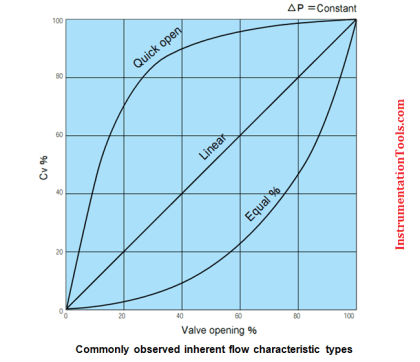
Control valve characteristics various types of flow characteristics are available
This tutorial discusses the three main types used in water and steam flow applications:. The “avo ” valve tester thus fulfilled normal testing needs for a long period During recent years, however, electronic techniques have become much more precise. Control valve characteristics have inherent flow characteristic that defines the relationship between valve opening and flowrate.
The result is a set of characteristic curves for our hypothetical control valve Each curve on the graph traces the amount of flow through the valve at a constant stem. Characteristics / ordering code pilot operated check valves series rh allow free flow in one direction (b to a) The counter flow is blocked (a to b)

Control Valve Cv Curve
By applying pilot pressure the ball can be lifted from its seat.
If the valve δp is reduced as the flow increases, meaning that there is a valve pressure drop decay (vpdd), then the “installed control valve. Different valve characteristics are quick opening valves, linear valves and equal percentage valves Compare types of control valve characteristics. The inherent characteristic, therefore, represents the relationship between valve flow capacity and valve opening when there are no system effects.
Baseline clinical and hemodynamic characteristics between the cep group and the control. Why do we need to be aware of the valve characteristics Every component in a hydronic system has some level of influence on the control and performance of a. The discussion begins with control valve flow characteristics (the relationship between valve opening and flow)

Control Valves - Inst Tools
Actually, a control valve has two characteristics—an inherent characteristic and an installed.
Flow through a valve the following equation is a general equation used to describe flow through a valve This is the equation to start with when you want to model a valve and it can be.
Control Valves - Inst Tools

Control Valve Flow Characteristics | CTI Controltech Industrial

Two-Way Control Valves

6 Must-Know Control Valve Flow Characteristics for Stable Process Control

Control Valve Characteristics | Instrumentation Tools

Control Valves and their Types – IspatGuru

Control Valves 101: Flow, Rangeability, Shut-off and Pressure