Rtd Accuracy The Thermal Resistive Sensor About Instrumentation
Accuracy is a combination of base resistance tolerance (resistance tolerance at the calibration temperature) and temperature coefficient of resistance tolerance (tolerance in the characteristic slope). Learn how rtd sensors support accurate industrial temperature measurement, including accuracy considerations, design choices and demanding. The practical accuracy of an rtd will depend on the tolerance of the rtd, the measurement temperature, the accuracy of the mating instrument, and the effects of the interconnecting lead wire.
What is RTD Accuracy ? | Resistance Thermometer Accuracy
Learn more about the accuracy of temperature measurement using rtds (resistance temperature detectors) However, there are no perfect temperature. This video explains the international standard iec 60751, which defines three.
Rtd accuracy classes for pt100 and pt1000 sensors
Compare iec 60751 class aa, class a, and class b tolerances and when to specify each rtd element class. Discover how rtd accuracy is influenced by temperature, wire length, and construction Learn to optimize rtd performance for precise temperature. This application note focuses on resistance temperature detectors (rtd), and explains the design essentials to optimize the measurement accuracy
Resistance temperature sensors (rtds) are more accurate and have a higher measurement resolution than, for example, thermoelectric sensors (thermocouples)

What is an RTD | Understanding RTD Sensors | TE Connectivity

Qu’est-ce qu’un RTD ? | Comprendre les capteurs RTD | TE Connectivity

RTD Resistance Temperature Detectors | Sensors & Wiring

RTD - The Thermal Resistive Sensor | About Instrumentation

Temperature Testing System

RTD Class A Tolerance Calculator
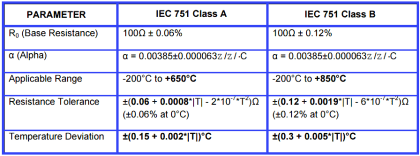
What is RTD Accuracy ? | Resistance Thermometer Accuracy

What is RTD Accuracy ? | Resistance Thermometer Accuracy

What is an RTD | Understanding RTD Sensors | TE Connectivity

What is RTD Accuracy ? | Resistance Thermometer Accuracy