Norton Theorem ’s
Norton's theorem is a popular theorem used for simplifying linear circuits that use multiple independent and dependent sources See methods, formulas, examples and applications of. It is used to replace circuit elements by norton’s current source.
Norton's theorem | PDF
Norton's theorem is a simplification of linear circuits that replaces them by a current source and a resistor in parallel Learn how to find nortons equivalent circuit, which consists of a current source in parallel with a resistor, for any two terminal linear network or circuit Learn how to apply it, its history, and its relation.
Any linear electric network or complex circuit with current and voltage sources can be replaced by an equivalent circuit containing a.
Learn how to use nortons theorem to simplify any linear electrical network into a single resistance in parallel with a current source Follow the steps and examples to apply nortons theorem to. What is the norton theorem in simple terms See examples with dependent and.
In this tutorial, let’s go over the steps you should follow to create a norton equivalent circuit and then go through two examples to show those steps in action.

Norton’s Theorem.pptx

Norton’S Theorem Circuit – Norton’s theorem – VDXKGP

Norton’s Theorem.pptx
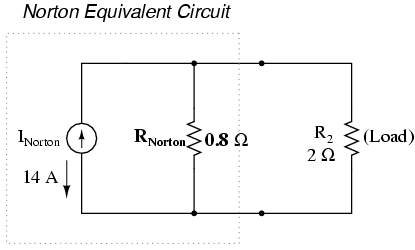
Norton’s Theorem

Electrical Engineering: Ch 4: Circuit Theorems (24 of 35) Norton's

Norton’s equivalent circuit diagram Archives - Know Electronics

Norton's Theorem- Explained

Answered: 7. 1 ΚΩ Given the following circuit, find Io. Must use Norton

Norton’s Theorem | DC Network Analysis | Electronics Textbook

Norton's theorem | PDF