Falling Ball Viscometer Principle Inst Tools
Falling ball viscometer uses the simple — but precise — höppler principle to measure the viscosity of newtonian liquids by measuring the time. Turn the tube 180 0 again the ball return to its start position. It measures the time a ball takes to move through the sample liquid
Viscometer and its types with working principle & applications.
To obtain viscosity values, a calibration with a viscosity reference standard and the sample's density are required. The sample viscosity is correlated with the time. Falling ball viscometer, model kf40, complies with the german industry standard din 53015
The measuring principle, according to höppler, is to determine the falling time of a ball in a cylindrical.
The haake falling ball viscometer measures the viscosity of transparent newtonian liquids This viscosity is correlated to the time a ball requires to fall a defined distance. The falling ball viscometer typically measures the viscosity of newtonian liquids and gases The method applies newton’s law of motion under.
The principle of the viscometer is to determine the falling time of a sphere with known density and diameter within a fluid filled inside glass tube The viscosity of the fluid sample is related to the time. The falling ball apparatus operates on a simple yet effective principle A ball, typically made of glass, steel, or plastic, is allowed to descend.

A falling sphere viscometer available in an undergraduate physics
A falling ball viscometer consists of a cylinder filled with the fluid in question into which a ball of known density and dimensions is dropped
The velocity was calculated from the time it took a falling ball to. Measuring principle the time for rolling and sliding movements of a ball through the sample liquid in an inclined cylindrical measuring tube is measured

Viscometer and its types with working principle & applications.
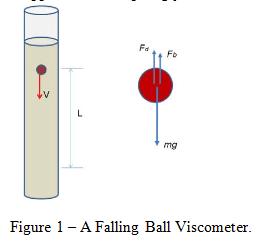
Stokes' Law, Reynolds Number, and Measuring Liquid Viscosity
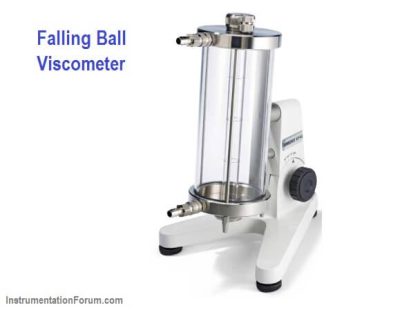
Falling Ball Viscometer Principle - Inst Tools

Falling ball viscosimeter.docx - Falling Ball Viscometer Principle

Fall ball Viscometer experiment fluid mechanicss | PPTX

Modern viscometer its types and application | PPTX
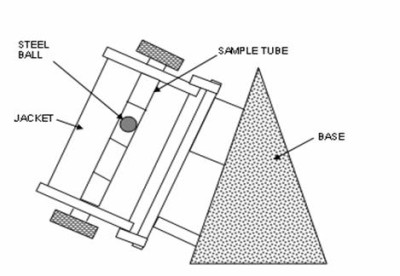
Measuring viscosity

Rheology | PPTX

Falling-ball viscometer Viscosity (cp) = Flow time × specific gravity×